
The Reckoning Is Already Here
The Weekend Windup #23 - Reflections, Cool Reads, Events, and More

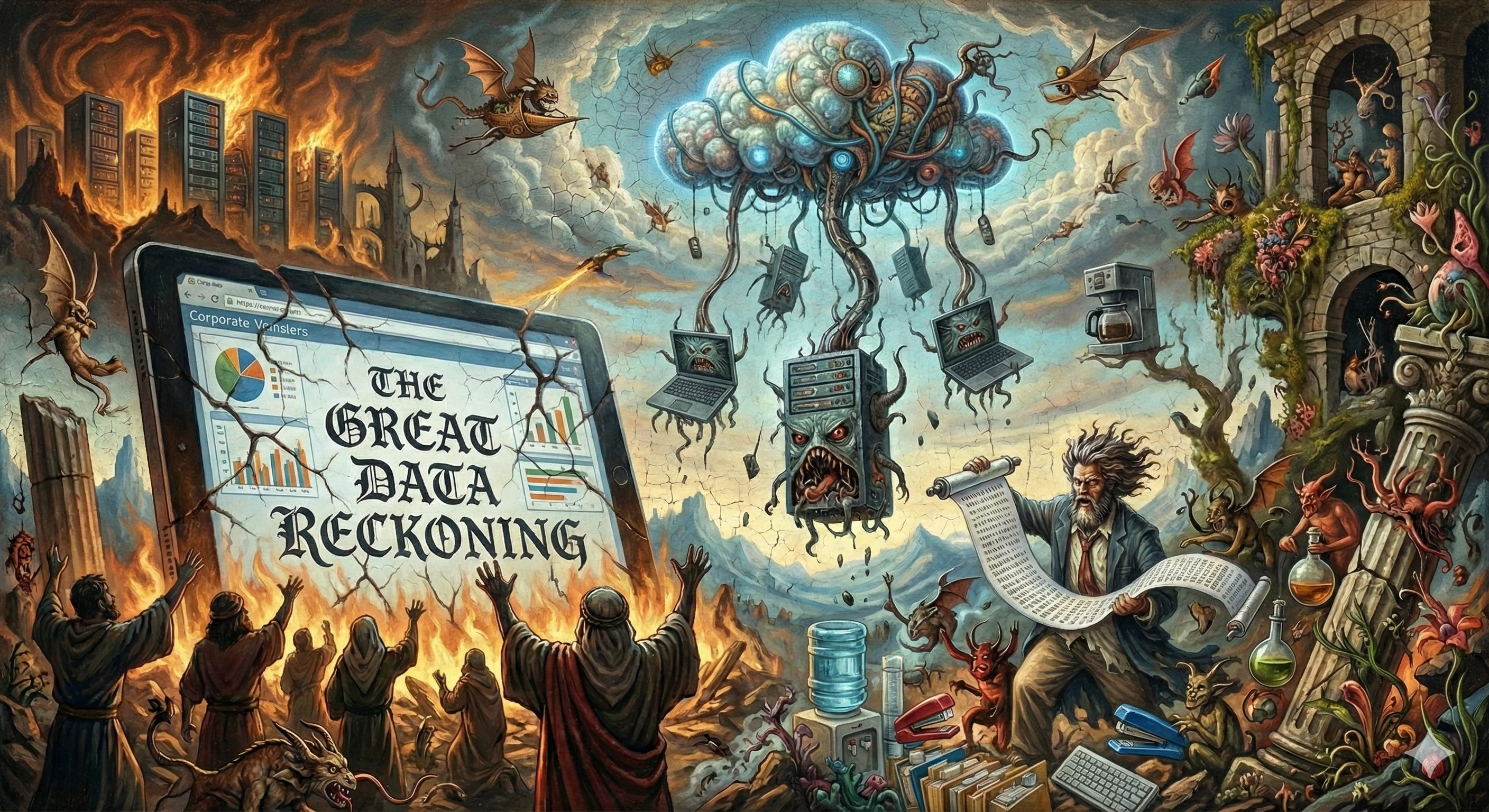
Earlier this week, I published a piece called 2028 — The Great Data Reckoning. It was supposed to be satire. A riff on the Citrini Research “2028 Global Intelligence Crisis“ paper that rattled the stock markets early this week, except pointed squarely at the data industry. A fictional memo from 2028 looking back at how everything unraveled. A faux masterpiece de jour, if you will, my dear friends.
By the time I re-read it later that day, it no longer felt like satire. As William Gibson said, “The future is already here - it’s just not evenly distributed.” The Great Data Reckoning is already here.
The article clearly struck a nerve. From what I saw, it was shared widely on LinkedIn, Substack, and in private Slack channels. That’s when I knew it had crossed some kind of threshold.
So I wanted to share some follow-up thinking that’s been rattling around my head this week, because the conversations I’ve been having since publishing that piece have only reinforced my sense that the timeline in my article might be optimistic.
Something Big Shifted Very Recently
I’ve had conversations this week with data engineers, founders, and investors. The universal vibe is that something changed in the last month or two.
I’m not talking about a gradual improvement. I mean a big change. The models got really good, seemingly overnight. What used to be a decently capable coding assistant that could write passable SQL is now producing production-quality work: pipelines, configurations, strategy documents, the works. Every new point release seems to surprise even people who use these tools daily. And I use and abuse them daily.
Multiple friends have independently told me the same thing: “I don’t know what happened, but something shifted.” The models crossed some threshold where the gap between “neat demo” and “this replaces actual work” effectively closed for a huge swath of tasks.
If you’re not feeling this shift, it’s probably because you’re not using the latest models. And if you’re not using the latest models, I hate to be that guy, but you’re woefully behind and out of step. Use the latest models ASAP.
My Own Workflow Is the Proof
Despite my occasionally crusty, cranky old man vibe, I’m staying current on what’s happening. I’m not just theorizing about this. I’m living it every day.
On a typical day, I have ChatGPT, Gemini, Codex, Claude Code, or Cowork running in the background pretty much nonstop, just building things for me and helping me with everything I can think of. It’s crazy these days. I wake up, turn on the AIs, and go make coffee. I mean, it feels wasteful not have them churning while I do something else, like waiting for my Nespresso machine to make me a cup of coffee, right? Weeks of work are compressing into hours. Hours of work are compressed into minutes.
As a lightweight example this week, I had Gemini in Google Workspace review my emails and extract all open action items buried across various threads. It did a phenomenal job. My task list? Working on automating much of that with agents. That used to be admin work I’d need to hire someone to do. Now it’s a task an agent does on a schedule. And I feel like things are just getting started. Again, the models and workflows improve almost weekly. What comes next week? Who knows.
If you’re building or maintaining production systems, the lesson from this is to use AI to reduce your toil, aka those repetitive tasks you do that suck your soul dry and should be automated. You’re bright (you’re reading this article ;) and need to spend your time doing things that matter, and automate the boring parts. This is engineering at its best.
Here’s the paradox I keep running into: for every task I automate, ten more things surface that I can now get to, as I noted a few weeks ago. Turns out, the bottleneck was never ideas or ambition. From what I’m now seeing, my biggest bottleneck was simply bandwidth. AI is blowing that open, which is both thrilling and a little terrifying to think about what it means for my calendar, as I’ve got even more things to build, not fewer. I have a goal to automate at least one thing in my life every day. And for each automation, that means at least 10 more things to address. So it goes.
The Bar Is Going Up…Way Up!
One uncomfortable takeaway from all of this is the bar for what you need to do to get paid is rising. Fast.
If your job can be described as “following documented procedures,” and let’s be honest, a lot of data engineering work falls into that category, the window is closing fast. AI’s becoming insanely more capable, and I don’t think the progress will stop, even if the AI Bubble bursts. AI just needs to be told what to do, and increasingly, the business users can tell it themselves.
I still happily pay for things where taste and judgment matter. I have designers working on my book because AI-generated design still lacks the nuance and taste that make something look great. It’ll produce something passable, sure. But passable isn’t acceptable when you’re putting your name on a physical book. The stuff that’s worth paying for right now is the stuff that requires a genuine human sensibility - aesthetic judgment, deep domain expertise, institutional knowledge, the ability to sit with ambiguity and make a call.
“AI Doesn’t Understand My Business”
This is the refrain I keep hearing from people who feel safe. And look, it’s still (mostly) true. Right now, AI doesn’t have deep context about your specific organization’s idiosyncrasies. It doesn’t know why your dbt job excludes New Jersey transactions on Tuesdays or why that one table is named final_v2_FIXED_actually_final_USE_THIS_ONE.
But here’s what I’ve learned: whatever you think AI is incapable of today, it’s going to surprise you sooner than you expect. Every time I’ve drawn a line and said, “It can’t do this,” the next model version has erased that line. I’ve given up trying to feel stodgy about AI. It will continue to improve, and that’s how it is.
And here’s the other thing nobody wants to say out loud: most engineers don’t understand the business either. A huge portion of the data workforce built careers around knowing which YAML config makes Tool A talk to Tool B. That’s not business context. That’s configuration knowledge. It’s like people who could drive railroad spikes, who were ultimately replaced by spike-driving machines. Writing configuration code is exactly the kind of thing AI can do without skipping a beat.
The people who will be fine are the ones who actually sit down with business users and ask, “What decision are you trying to make?” or “What outcome are you trying to achieve?” Try to place your job at the center of revenue-generating activities, not cost-center ones. If you can directly attribute your value to revenue, you’re in a good spot. If your value proposition is “I know how to use dbt,” I love dbt, but it’s also a means to an end. It’s not the job. If this is you, I’d start diversifying.
So What Do You Do?
If there’s one thing I want you to take away from both the original article and this follow-up, it’s that the Great Data Reckoning isn’t a 2028 event. It’s happening right now. Some people I talk to - senior folks who’ve been in this industry for decades - are thinking about pivots and next moves. They’re not necessarily panicking, but because they’re paying attention and can spot an inflection point when they see one. This might be the mother of all inflection points.
If you’re not already doing so, here’s what I’d tell you to do today:
Get good at AI. Now. I genuinely cannot believe I still have to say this in 2026, but some people tried ChatGPT two years ago, decided it sucked, and haven’t revisited. The models from two years ago did suck, relatively speaking. The current ones are a different animal. If your company won’t pay for AI tools, spend the $20/month yourself. It’s an investment in your future, and you can afford it.
Get closer to the business. If you’re a cost center with a hard time justifying what you do, you should be concerned. Find a way to put yourself in the line of fire of revenue. Understand the “why” behind the data, not just the “how” of moving it.
Build things that matter. Institutional knowledge, domain expertise, relationships, judgment - these are the moats. Not tool proficiency. Not stack knowledge. The tools are being commoditized. The human judgment layer is what’s left.
Find your tribe. As AI automates more of the mechanical work, people will crave human connection and candid conversation more than ever. Go to meetups, low key happy hours and conferences. Join online communities. Shameless plug - the need for community is a big reason why I built the Practical Data Community Discord, where almost 3,000 people have real conversations about where this industry is heading, among other things.
The world is changing at warp speed. The Great Reckoning is already here. Move accordingly.
Also, listen to this as a podcast. Available on Spotify, Apple, and wherever else you get your podcasts. Please support the show with a review. It means a lot.
Have a great weekend,
Joe

Modern data modelers need to live at the intersection of business and tech. Ellie.ai allows you to collaborate effectively with business while maintaining credibility with the Tech team. Get contextual support from AI, reverse engineer anything building a repository of sources with synthetic AI generated contextual metadata while delivering insights via an MCP Server and integrating anything with full blown API support.
The full stack data modeling future is here today!
Thanks to Ellie.ai for partnering on this newsletter.
Awesome Upcoming Events
All technical. All data. All day.
On March 26, 2026, there’s a very cool single-track, deeply technical data engineering event in San Francisco.
Capped at 100 practitioners.
No salespeople. No sponsors. Just talks + the hallway track, followed by happy hour.
When: March 26, 2026 · 10am–4pm + happy hour
Where: L4, 945 Market St, San Francisco
Thanks to Confluent for partnering on this event and newsletter.
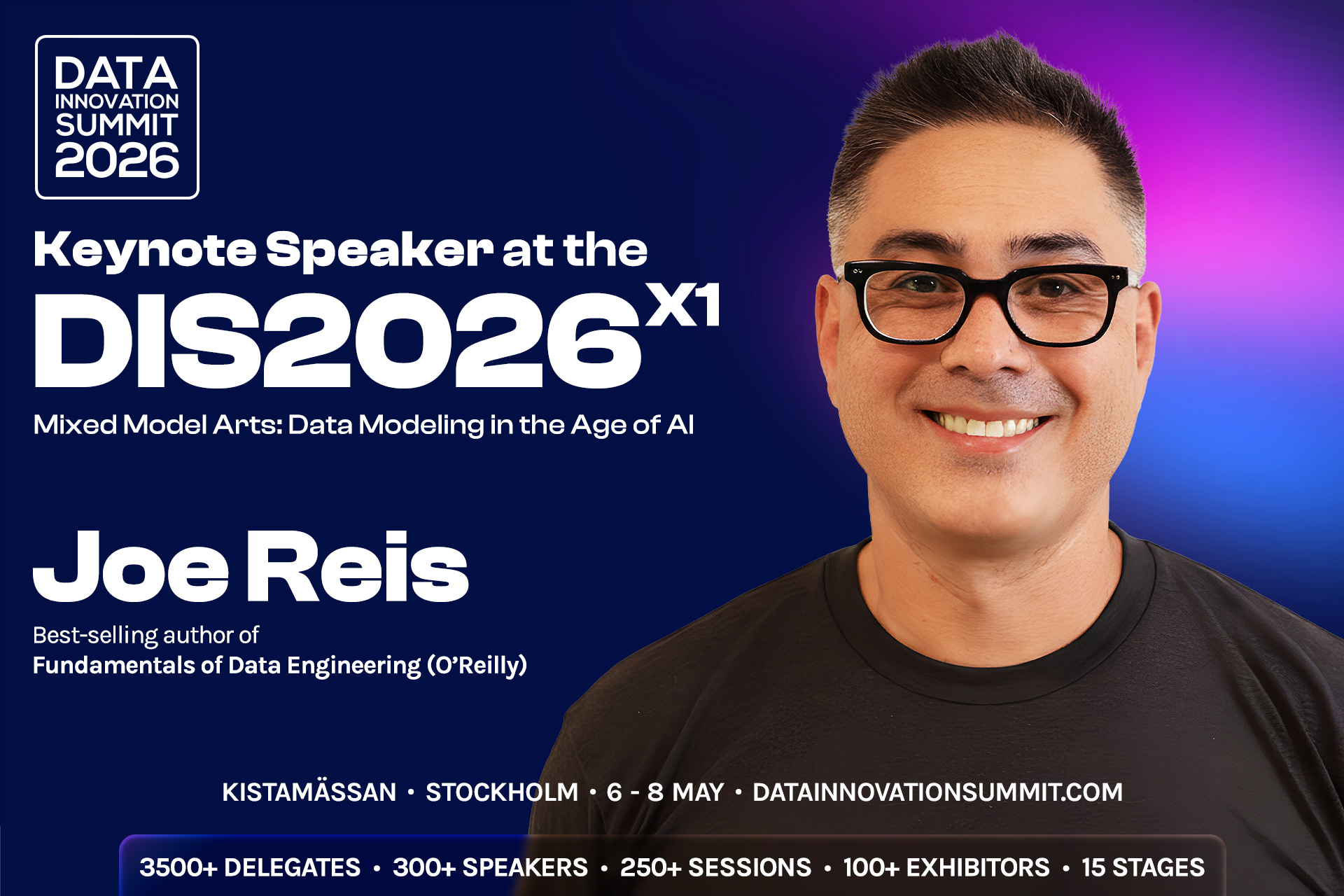
🇸🇪 Sweden! See you at the Data Innovation Summit in Stockholm.
I’m doing a keynote and workshop on Mixed Model Arts: Data Modeling in the Age of AI.
May 7 - keynote
May 8 - workshop
Here’s 10% off: SD10OFF (good for the event. Workshop is not included)
Register here
But wait, there’s more!

Cool Videos and Reads
In this episode, I sit down with Prashant Sridharan, a 30-year veteran of developer marketing who has shaped go-to-market strategies for tech giants like Sun Microsystems, Microsoft, AWS, Facebook, and Twitter, and currently runs product marketing at Supabase. We dive deep into the origins of DevRel and how marketing to developers has evolved in an increasingly noisy, AI-saturated landscape.
Here’s a talk I gave in Paris at Forward Data Conference (easily one of the best indie data conferences on the planet). It just dropped. Check it out. Merci.
Check out the 2026 Practical Data Community State of Data Engineering: Interactive analysis tool + dataset
The survey has an alternative super corporate BI tool, complete with 3D donut charts and speedometer charts, exports to Lotus and Crystal Reports, and more. Cutting edge BI tooling at its finest.
Here are some things I read this week that you might enjoy.
The Great Zipper of Capitalism - by Scott Werner
The Fundraising Tactic AI Startups Are Using to Juice Valuations
Brace for the Fuckening | justin․searls․co
What Data Modeling Is and Is Not - by Joe Reis
Meta Director of AI Safety Allows AI Agent to Accidentally Delete Her Inbox
2028 - THE GREAT DATA RECKONING - Joe Reis
The persona selection model \ Anthropic
How we rebuilt Next.js with AI in one week
Software development now costs less than than the wage of a minimum wage worker
Fragmentation to framework: Spec-first development at Benchling | by Eli Levine | Feb, 2026
Yes, You’re Royally Screwed. Now Here’s What to Do About It.
The Lunatics are taking over the Asylum
Find My Other Content Here
📺 YouTube - Interviews, tutorials, product reviews, rants, and more.
🎙️ Podcasts - Listen on Spotify or wherever you get your podcasts
📝 Practical Data Modeling - This is where I’m writing my upcoming book, Mixed Model Arts, mostly in public. Free and paid content.
The Practical Data Community
The Practical Data Community is a place for candid, vendor-free conversations about all things tech, data, and AI. We host regular events such as book clubs, lunch-and-learns, Data Therapy, and more.
"And here’s the other thing nobody wants to say out loud: most engineers don’t understand the business either. "
^THIS! I hear so many folk talk about how data people are needed because AI can't do this - but I'm always like "well, data professionals are often terrible at this now as well!"
I'm not a AI-doomer ("It'll take our jobs!"), but I do think it may mean bad data professionals are weeded out and to stay ahead of the game, others may have to work much harder in being more visible to the enterprise.
Pontificating more on this, I think the only moat left at this point is the governance and security. Once corporations feel comfortable with the models actually connecting to the databases and analyzing the data…oh sh** watch out! The moats will collapse