
The Vibes Stack: A Technical Deep Dive
A Deep Architecture Dive into How to Make Vibe Graphs a Reality

By the Practical Data Capital Vibe Infrastructure Research Desk
Last month, we published our thesis on Vibes Graphs: AI’s Trillion-Dollar Opportunity. The response was overwhelming. Our inboxes filled with a single question:
“Okay, but how do you actually build this?”
Today, we’re going deep on the architecture. This is the vibes stack—the infrastructure required to capture, process, store, and query organizational sentiment at scale.
Fair warning: this post gets into the weeds. If you’re a vibe-curious executive, you might want to forward this to your Chief Vibe Officer and let them summarize.
The Reference Architecture
Let’s start with the high-level architecture. A production-grade vibes stack consists of five layers:
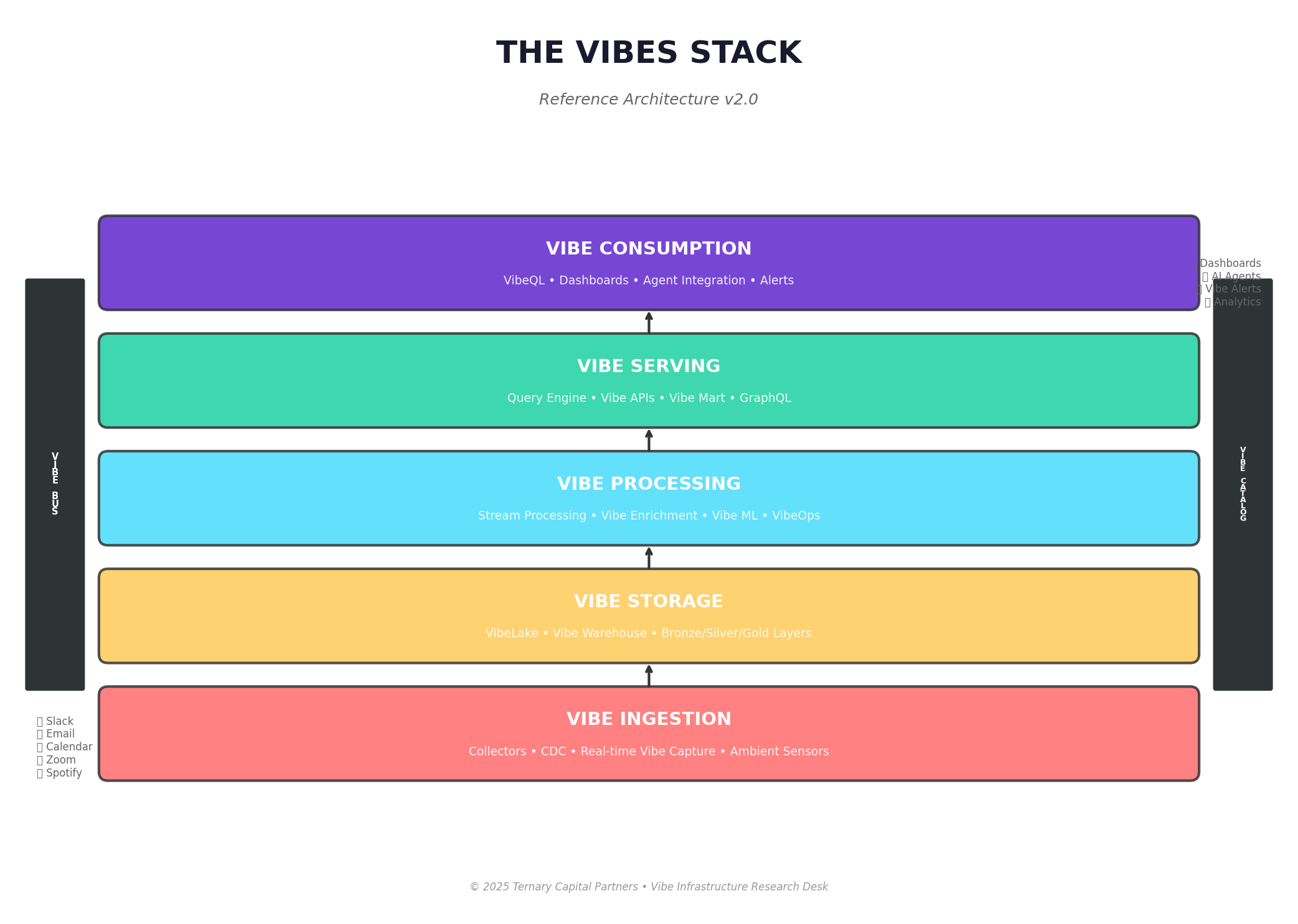
Each layer has distinct responsibilities and failure modes. Let’s walk through them.
Layer 1: Vibe Ingestion
The ingestion layer is where most vibes stacks fail before they start. The fundamental challenge is that vibes are ambient, ephemeral, and high-cardinality. You can’t just poll for vibes. You have to be passively sensing the full organizational surface area at all times.
Vibe Capture Patterns
There are three primary patterns for vibe capture:
1. Passive Ambient Sensing (PAS)
This is the gold standard. You instrument the surfaces where vibes naturally emit—communication tools, productivity apps, calendar systems—and capture the vibe exhaust in real-time.
The key insight: you must capture vibe signals, not content. Vibes are metadata, not data.
What does a vibe signal look like? Consider Slack. You’re not capturing what people say—you’re capturing:
Punctuation energy: The difference between “Thanks!” and “Thanks.” and “Thx”
Emoji velocity: How many emojis per hour, and are they increasing or decreasing?
Response latency: Did they reply in 30 seconds or 3 hours?
Edit frequency: How many times did they revise before sending?
Caps ratio: ARE THEY YELLING or are they calm
Each of these is a vibe signal. Individually, they’re noise. Aggregated across time and surfaces, they form a vibe fingerprint.
2. Active Vibe Probing (AVP)
For surfaces where passive sensing isn’t possible, you can deploy vibe probes—lightweight instrumentation that captures ambient signals at decision points.
Consider calendar invites. When someone receives a meeting invite, the system can capture:
Response delay: Accepted in 4 minutes = engaged. Accepted in 4 days = resentful.
Meeting dread score: Based on attendee list, duration, and time slot
Decline cowardice index: How long they hovered over “Decline” before clicking “Maybe”
Calendar density: Are they overloaded? This affects vibe interpretation.
Research shows that meetings accepted with high dread scores have 73% higher rates of “can we take this offline?” outcomes.
3. Synthetic Vibe Reconstruction (SVR)
When you can’t instrument in real-time, you can reconstruct vibes from historical artifacts. This is lossy—you’re recovering maybe 30-40% of original vibe fidelity—but it’s better than vibe-blindness.
Consider email metadata reconstruction:
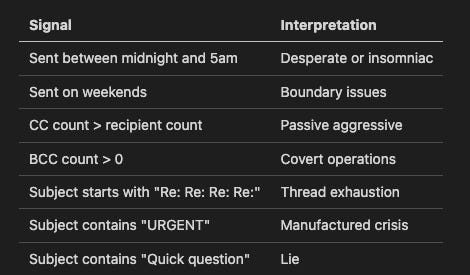
This is crude compared to real-time sensing, but it’s better than nothing.
The Vibe Bus
All collectors publish to a central Vibe Bus—a high-throughput, low-latency message broker optimized for vibe semantics.
Why not just use Kafka? You could. Many teams do. But Kafka was designed for events, not vibes. Vibes have unique characteristics:
Vibe Coalescence: Multiple weak vibe signals often merge into a single strong vibe. Your bus needs native support for vibe aggregation.
Vibe Decay: Vibes have a half-life. A vibe signal from 4 hours ago is worth less than one from 4 minutes ago. Your bus needs TTL-aware routing.
Vibe Contagion: Vibes spread. One person’s bad vibe infects the thread. Your bus needs to track vibe propagation paths.
Vibe Interference: Two opposing vibes can cancel out or amplify unpredictably. Your bus needs quantum-vibe-aware partitioning.
We’re seeing startups build vibe-native message brokers. Apache Ambiance (still in incubation) and Amazon Kinesis Vibes (rumored for re:Invent 2026) are worth watching.
Layer 2: Vibe Storage
Once you’re capturing vibes at scale, you need somewhere to put them. This is where the VibeLake comes in.
The Medallion Architecture for Vibes
If you’re familiar with modern data architecture, you know the medallion pattern—Bronze, Silver, Gold layers of progressive refinement. Vibes follow the same pattern:
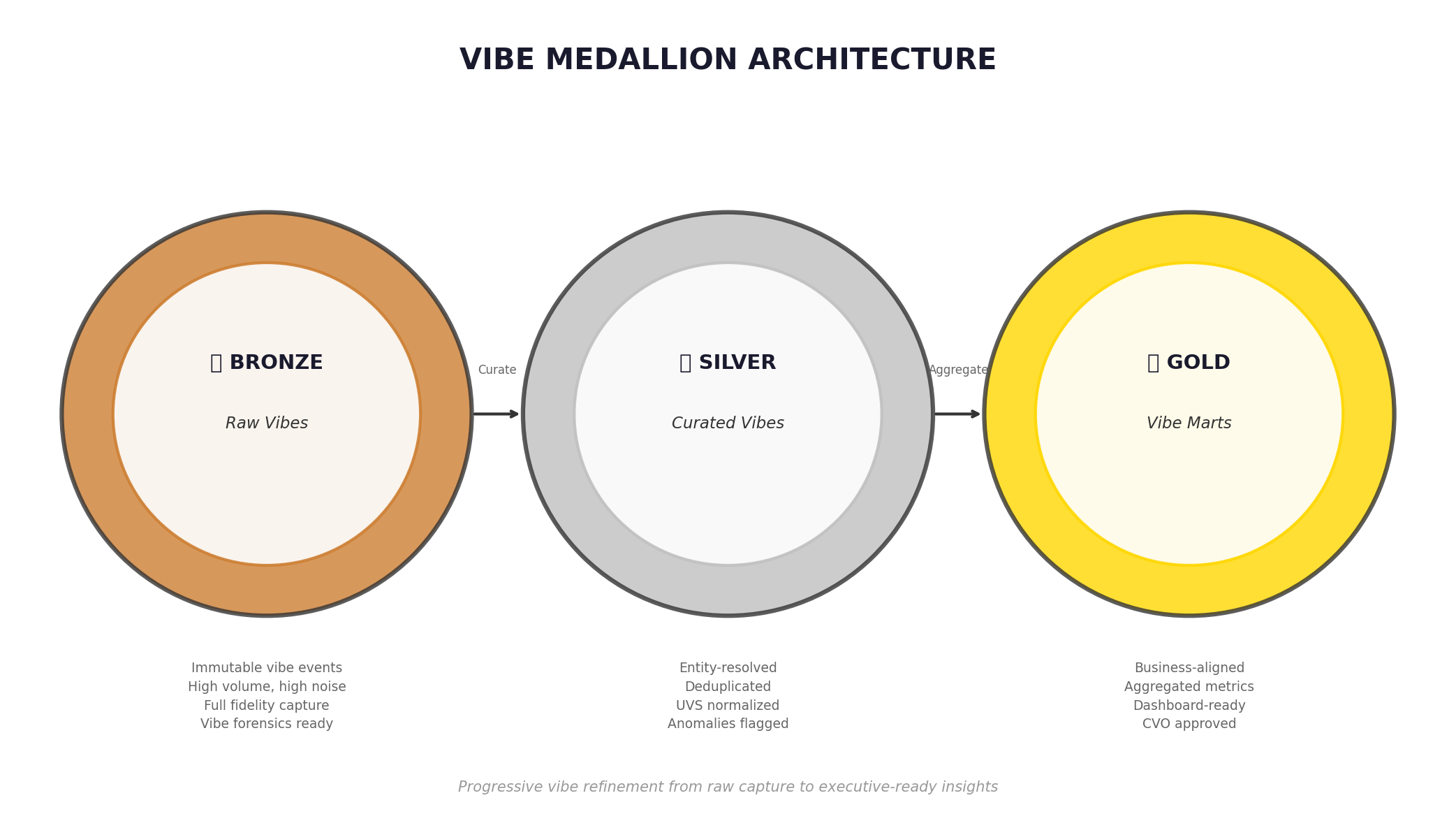
Bronze Layer: Raw Vibes
This is your immutable vibe record—every vibe signal as it was captured, warts and all. You keep this for compliance, replay, and vibe forensics.
Storage considerations:
Vibes are surprisingly compressible. The human emotional range is finite.
Partition by surface first, then time. Vibe queries are usually surface-specific.
Retain raw vibes for 7 years. You never know when you’ll need to reconstruct the vibe context of a decision made in 2019.
Don’t forget Spotify data. This is critical for Bon Iver detection.
Silver Layer: Curated Vibes
The silver layer is where vibe resolution happens. Raw vibe signals are noisy—you might get 50 signals per minute from an active Slack user. The silver layer consolidates these into canonical vibe states.
Key transformations:
Vibe Deduplication: Collapse redundant signals into representative vibes
Entity Resolution: Map surface-specific identities to canonical entities (”sarah.chen@company.com“ in email = “schen” in Slack = “Sarah C.” in Zoom = that person who always has a cat in their background)
Vibe Normalization: Convert surface-specific vibe scales to the Universal Vibe Scale (UVS), ranging from -1 (terrible vibe) to +1 (immaculate vibe)
Monday Normalization: Apply the standard -0.15 Monday Effect adjustment
Outlier Handling: Flag anomalous vibes for review (sudden vibe shifts may indicate life events, not organizational dynamics)
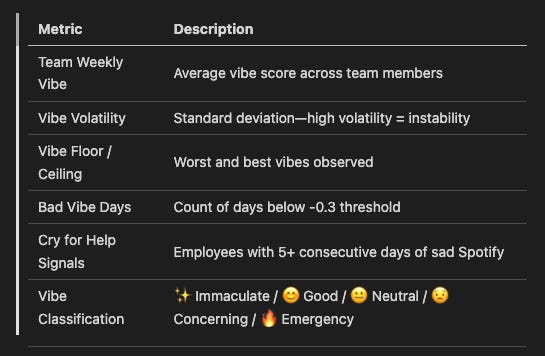
Gold Layer: Vibe Marts
The gold layer is where vibes become business-readable. This is what your Chief Vibe Officer looks at. This is what feeds the dashboards.
Vibe marts are aggregated, denormalized, and aligned to business concepts:
Layer 3: Vibe Processing
Storage is table stakes. The real value is in vibe processing—transforming raw ambient signals into actionable vibe intelligence.
Stream Processing for Vibes
Vibes are inherently streaming. Batch processing vibes is like batch processing your emotions—technically possible, but you’ve already missed the moment.
We recommend a Lambda Architecture for Vibes:
Speed Layer: Real-time vibe stream processing for immediate alerts (”🚨 Vibe collapse detected in #sales-team”)
Batch Layer: Nightly vibe reconciliation for historical accuracy and vibe forensics
Serving Layer: Unified vibe view that merges real-time and historical perspectives
The speed layer is critical. When a manager’s vibe drops below -0.5, you have approximately 2-4 hours before that bad vibe propagates to their direct reports. Real-time processing gives you a window for intervention.
Vibe Enrichment
Raw vibes lack context. The enrichment layer joins vibe signals with everything needed for interpretation:
Entity context:
Team, department, tenure
Is this person a manager? (Manager vibes propagate downward)
Days since last promotion (resentment builds)
Days until stock vesting cliff (vibes crater 30 days before, spike immediately after)
Temporal context:
Is it Monday? (Apply -0.15 adjustment)
Is it Friday afternoon? (Vibes artificially elevated)
Is it end of quarter? (All vibes are unreliable)
Is it the day after an all-hands? (Vibe hangover period)
Organizational context:
Recent reorg? (Vibes are in flux)
Open positions on team? (Overwork anxiety)
Team attrition rate? (Survivor guilt or relief)
Manager’s current vibe? (Vibes flow downhill)
The Monday Effect alone is responsible for 52 false positive vibe alerts per year if you don’t normalize for it.
Vibe ML
Machine learning on vibes unlocks predictive vibe intelligence:
Vibe Forecasting: What will this team’s vibe be in 7 days? LSTM models trained on historical patterns can predict with surprising accuracy—especially around predictable events like board meetings, earnings calls, and performance review cycles.
Vibe Contagion Modeling: Graph neural networks can model how vibes spread through organizational networks. Key finding: manager vibes should be weighted 3x in propagation models. Skip-level vibes only 0.5x.
Vibe Clustering: K-means clustering reveals distinct vibe archetypes in your organization:
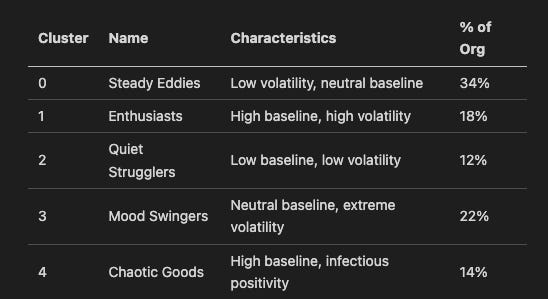
The “Quiet Strugglers” cluster is your early warning system. These employees won’t tell you they’re struggling. Their vibes will.
Layer 4: Vibe Serving
You’ve captured, stored, and processed vibes. Now you need to serve them.
VibeQL: A Query Language for Vibes
SQL wasn’t designed for vibes. It lacks native support for vibe semantics—temporal vibe windows, vibe decay functions, cross-entity vibe correlation.
Enter VibeQL, a purpose-built query language for vibe analytics:
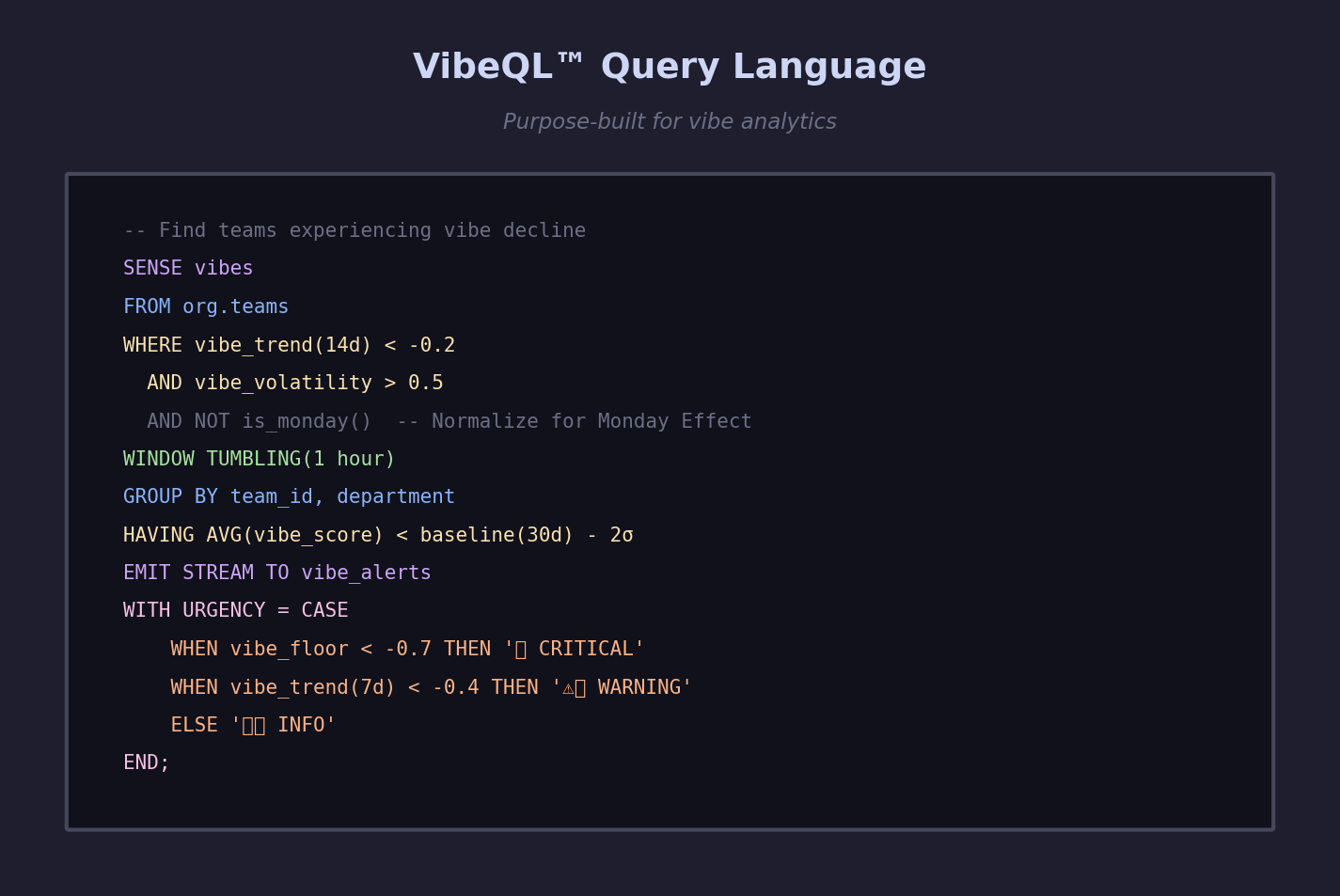
Key VibeQL innovations:
SENSEinstead ofSELECT—because you’re sensing vibes, not selecting datavibe_trend(interval)—built-in function for calculating vibe trajectorybaseline(interval)—reference an entity’s historical vibe baselineis_monday()—because Monday normalization is so common it deserves a keywordEMIT STREAM—first-class streaming output for real-time alerting
The Vibe API
For programmatic access, the Vibe API returns rich context alongside raw scores:
Entity Vibe Response:
Entity: sarah.chen
Current Vibe: 0.34 (😐 Neutral)
Confidence: 87%
7-Day Trend: -0.12 (declining)
Contributing Signals: 47
Anomaly Flags: None

Context:
- Is Monday: No
- Days Since Last PTO: 45 (concerning)
- Meeting Load: 78th percentile (high)
- Current Spotify: Bon Iver - Holocene 🚨
The Spotify field is not a joke. We’ve found that 5+ consecutive days of Bon Iver, Radiohead, or Elliott Smith is a leading indicator of attrition risk.
Layer 5: Vibe Consumption
The top of the stack is where vibes become actionable.
Vibe Dashboards
Every Chief Vibe Officer needs a command center:
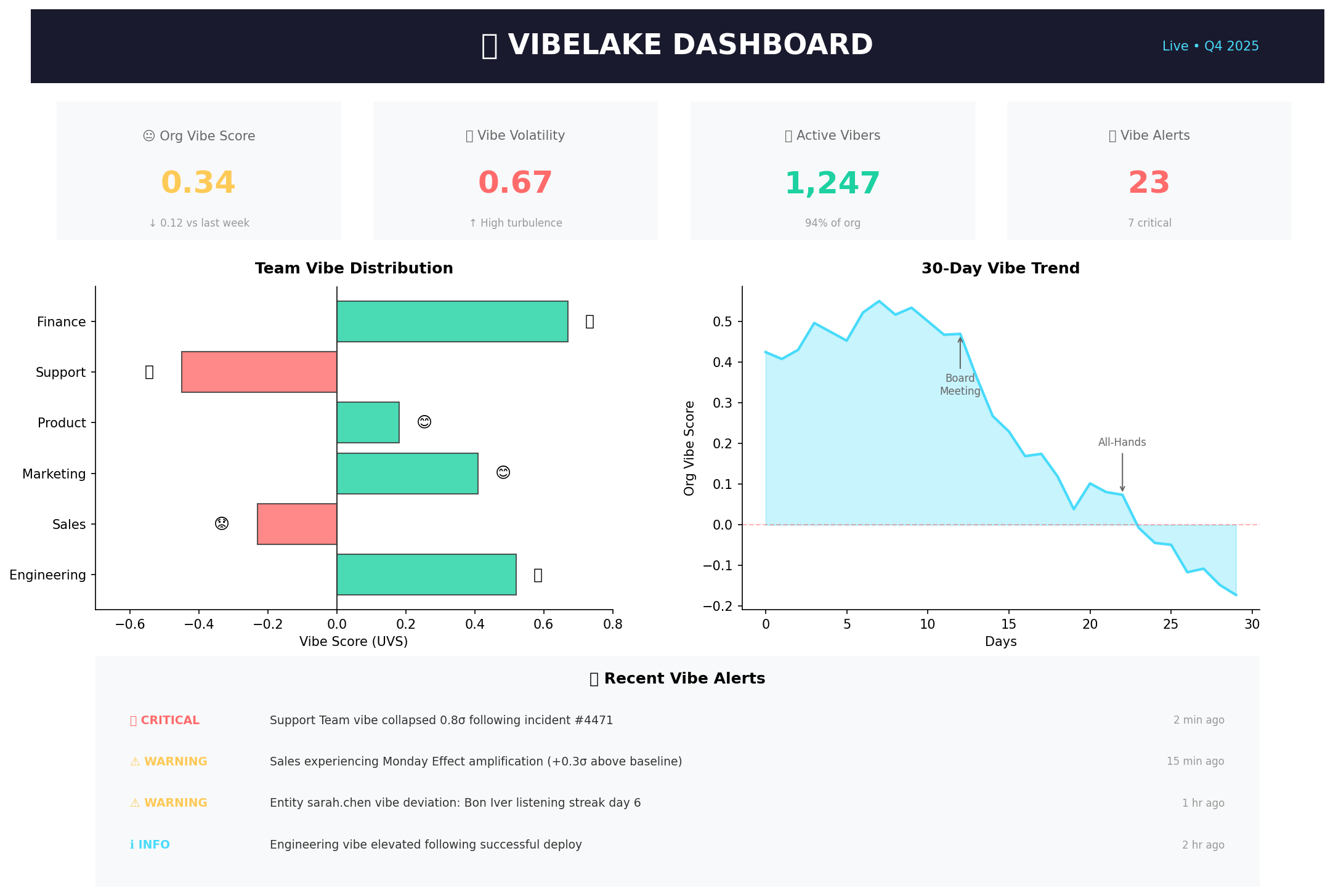
Key dashboard components:
Org Vibe Score: The single number that tells you if things are okay
Vibe Volatility: High volatility = instability, even if average vibe is good
Team Vibe Distribution: Identify which teams need attention (Support is always red)
30-Day Vibe Trend: Are things getting better or worse? What events correlate?
Recent Vibe Alerts: What requires immediate attention?
Note the alert panel. “Entity sarah.chen vibe deviation: Bon Iver listening streak day 6” is exactly the kind of signal that would be invisible in traditional HR systems but is immediately surfaced by a mature vibes stack.
Agent Integration
The real power of the vibes stack is feeding vibe context to AI agents. Remember: agents are vibe-blind by default. The vibes stack gives them sight.
Consider a renewal agent evaluating a customer contract. Traditional inputs: contract terms, usage data, support ticket history.
With vibe context, the agent also knows:
The sales rep who closed this deal was at 94% quota attainment with 3 days left in quarter (desperate energy)
The customer had evaluated 4 vendors over 6 months before signing (skeptical but fatigued)
The executive sponsor was distracted by a concurrent M&A process
The broader organizational vibe was artificially elevated (stock up 12% that week)
That’s the context that tells you this deal was closed under duress and the renewal will be a battle. No system of record captures this. The vibes graph does.
The Vibe Maturity Model
Not every organization is ready for a full vibes stack. We’ve developed a maturity model to help you assess your vibe readiness:
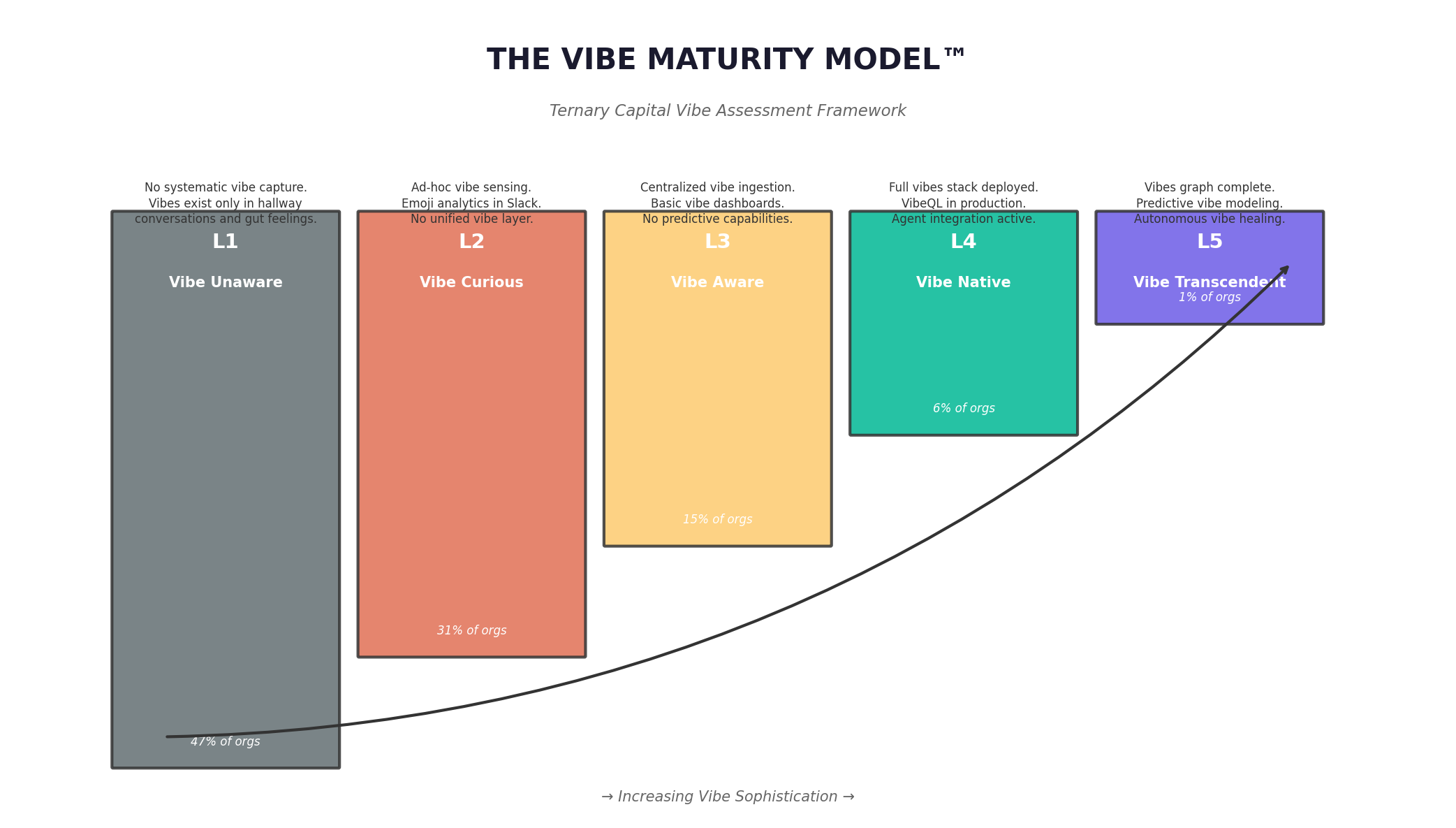
Level 1: Vibe Unaware (47% of organizations)
No systematic vibe capture
Vibes exist only in hallway conversations and gut feelings
“We have a great culture” (source: vibes)
Level 2: Vibe Curious (31% of organizations)
Ad-hoc vibe sensing
Someone built a Slack emoji analytics dashboard
No unified vibe layer
“We should do an engagement survey”
Level 3: Vibe Aware (15% of organizations)
Centralized vibe ingestion
Basic vibe dashboards
No predictive capabilities
“Our eNPS is 42”
Level 4: Vibe Native (6% of organizations)
Full vibes stack deployed
VibeQL in production
Agent integration active
“Our vibe trend suggests Q4 retention risk”
Level 5: Vibe Transcendent (1% of organizations)
Vibes graph complete
Predictive vibe modeling
Autonomous vibe healing
Vibes as a competitive moat
“We preemptively addressed the vibe collapse before it propagated”
Most enterprises are stuck at Level 2. They’re vibe-curious but lack the infrastructure to move beyond ad-hoc sensing.
Implementation Considerations
Build vs. Buy
The vibes stack is complex. Most organizations should buy, not build.
When to build:
You have 10+ engineers with ambient sensing experience
Vibes are a core competitive differentiator
You need custom vibe semantics for your industry
When to buy:
You just want vibe insights without the infrastructure burden
You’re below Level 3 on the Vibe Maturity Model
Your CVO is asking for dashboards, not architecture diagrams
Vendors to Watch
The vibe infrastructure market is nascent but growing rapidly:
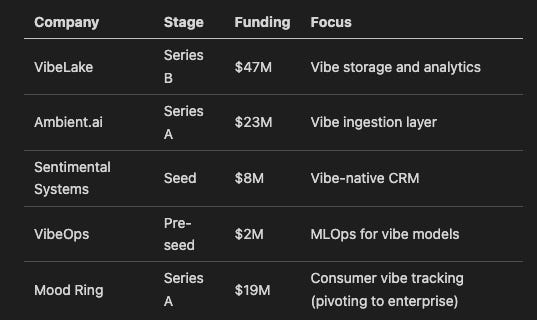
We’re also watching Apache Ambiance, an open-source vibe bus project currently in incubation. Early, but promising.
Common Pitfalls
1. Vibe washing Rebranding your annual employee engagement survey as “vibe capture.” Real vibes are ambient and continuous, not solicited and periodic.
2. Over-indexing on Slack Slack vibes are important but represent only ~30% of organizational vibe surface area. Don’t ignore calendar, email, Zoom, and yes, Spotify.
3. Ignoring the Monday Effect If you’re not applying the -0.15 Monday normalization, you’ll have 52 false positive vibe alerts per year. This is the #1 mistake we see.
4. Vibe alert fatigue Start with high-severity alerts only. A 0.3σ deviation is noise, not signal. Reserve alerts for 2.5σ+ events.
5. Storing content instead of signals You want the punctuation pattern, not the message. You want the response latency, not the response. Vibes are metadata. If you’re storing content, you’re doing it wrong (and probably violating privacy regulations).
6. Forgetting vibe decay A vibe signal from last week is worth less than one from today. Your models need time-decay weighting or you’ll be making decisions based on stale vibes.
What’s Next
The vibes stack is still early. We’re tracking several emerging trends:
Multimodal vibe sensing: Video call micro-expression analysis, voice tone detection, and (controversially) keystroke pressure sensors. The surface area for vibe capture is expanding.
Vibe simulation: What-if analysis for organizational changes. “If we announce layoffs on Thursday, what happens to engineering vibes? What if we do it on Friday?” This is becoming possible as vibe models mature.
Cross-company vibe benchmarks: “Our sales team vibe is 0.4σ below industry median.” Anonymized vibe benchmarking is a logical next step.
Vibe-based compensation: Controversial, but some companies are experimenting with vibe metrics as inputs to performance evaluation. We have concerns, but we’re watching.
Autonomous vibe healing: Level 5 organizations are beginning to deploy agents that automatically intervene when vibe patterns suggest emerging problems—scheduling 1:1s, suggesting PTO, adjusting workloads—without human intervention.
The Bottom Line
The infrastructure layer is being built right now. The startups that own the vibes stack will own the context layer for the agentic era.
The question isn’t whether organizations will capture vibes—they will. The question is whether you’ll be leading with vibe intelligence or playing catch-up.
The wall isn’t missing data. It’s missing vibes.
This article was vibed with Claude Opus 4.5. The author is a partner at Practical Data Capital, which focuses on vibe-native infrastructure and ambient enterprise intelligence. They reserve the right to fund whatever they just made up.
For inquiries about vibe architecture consulting, reach out to our Vibe Infrastructure Research Desk at joe@joereismedia.com.
This article feels like you are trying to rank for the vibe keyword on Google 🤣
Where do “KVI” and “vibe-splaining” fit into this? Key Vibe Indicators and OVR (Objectives and Vibe Results) are trending in performance evaluations and investor conference calls with managements.