
What I'd Do As a Junior Candidate in Mid-2026
The Weekend Windup #37 - Cool reads, events, links, and more

Save serious money on your cloud costs with Revefi’s new autonomous AI DBA, a tool built to handle the gritty reality of cloud data management so you can stop babysitting your infrastructure.

With a five-minute, zero-touch setup, it deploys 18 specialized agents across your data estate to automatically manage FinOps, performance tuning, and data quality. If you want to cut your cloud costs by 30% to 70% and get back to actual data architecture, check out what they are building at revefi.com/ai-dba
Thanks to Revefi for partnering with me on the newsletter and podcast.
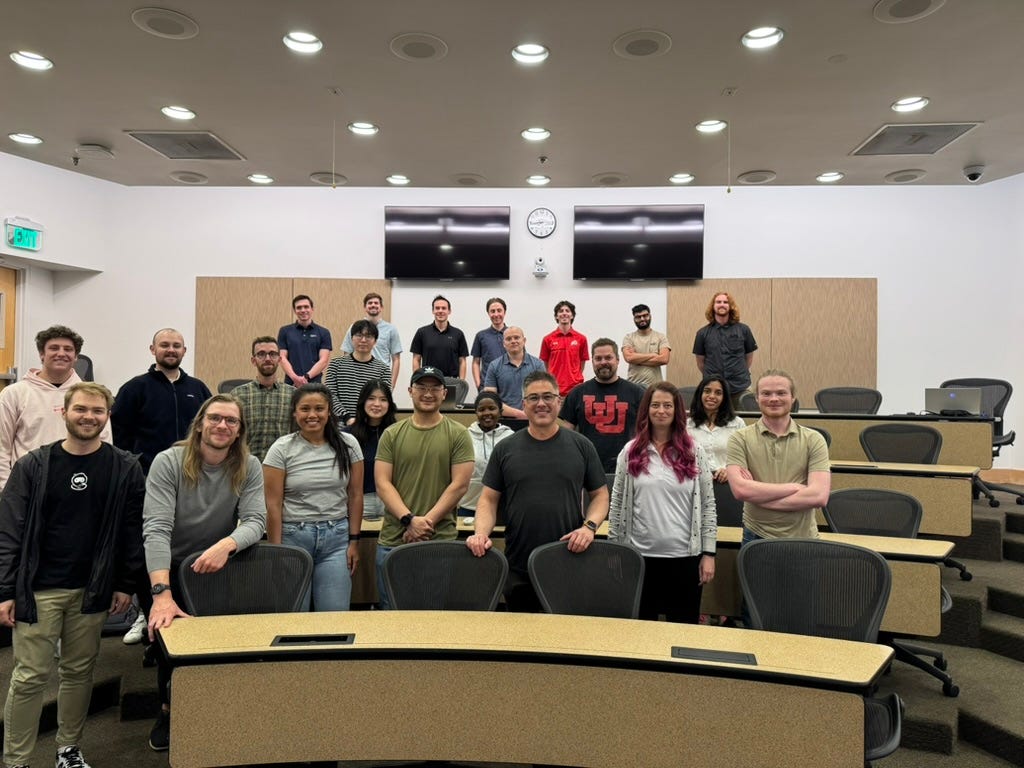
Yesterday I did a fireside chat and Q&A with a data team. Even though I’m booked solid, I enjoy these sorts of things every once in a while. These discussions help me get different perspectives on what’s going on in the world. And hopefully I can impart some modicum of good advice to teams, but no guarantees.
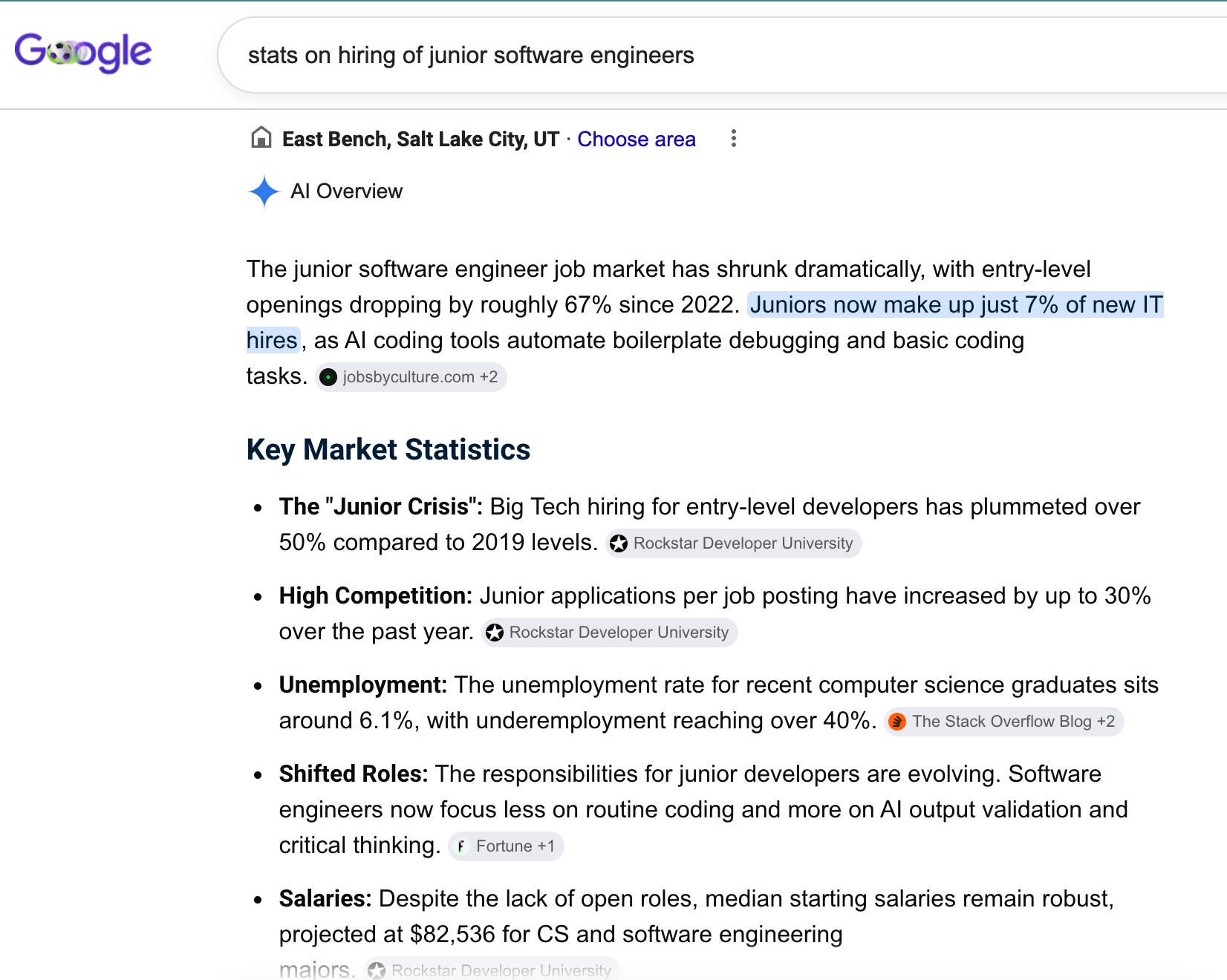
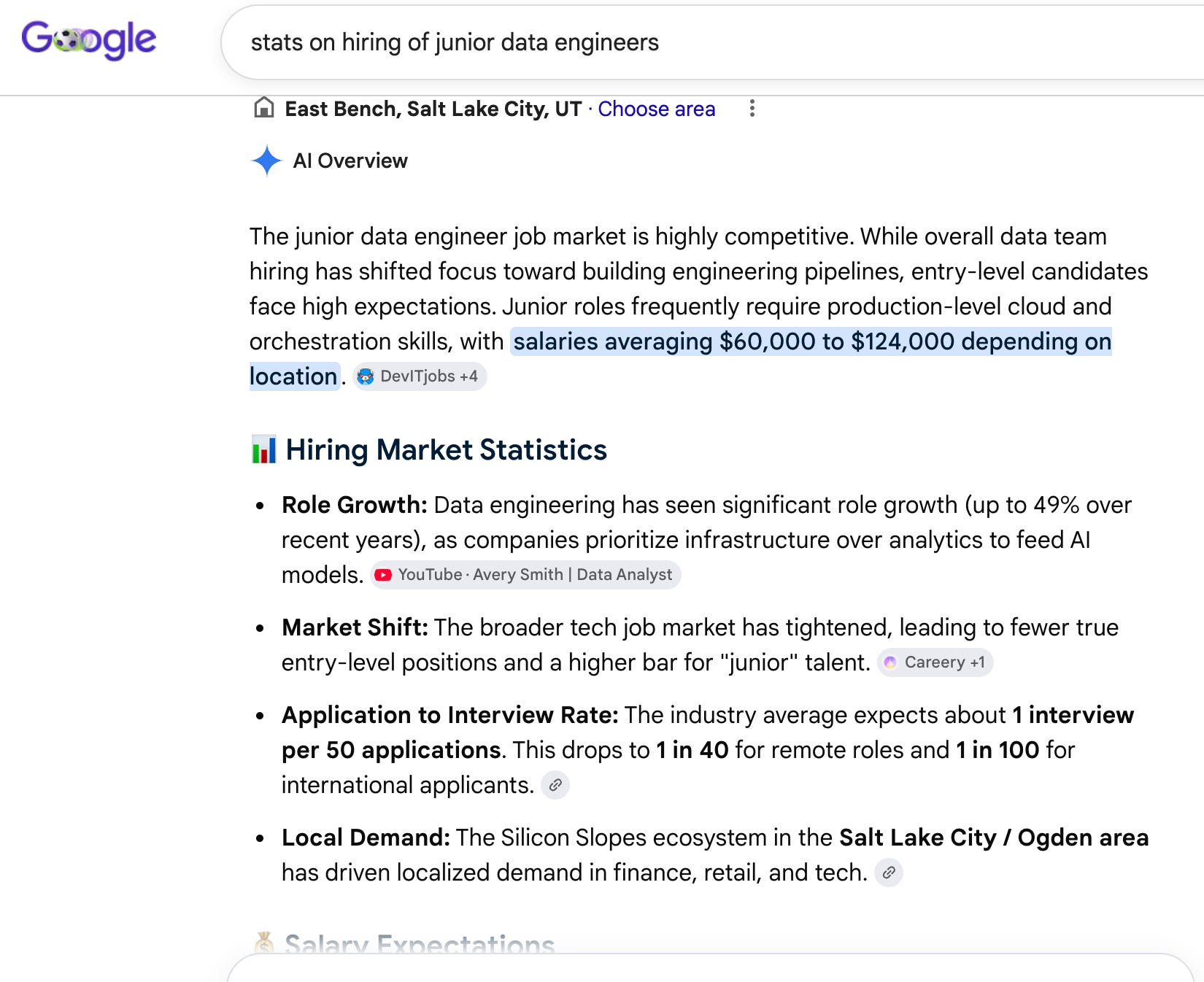
An intern on the data team asked, “I’m new in my career. What should I do?” I get this question a lot, either through messages or when I’m on the road. And it’s the type of question that’s always existed, but nowadays has a few new twists. Many juniors just graduated, and the job market for juniors isn’t what it used to be. Let’s look at some quick and dirty stats on the hiring of junior software and data engineers.
Here’s a screenshot of Google’s AI overview on “stats on hiring of junior software engineers.”
And here’s the same query for junior data engineers. Data scientists and analysts aren’t faring much better (see Google for yourself).
For people entering the workforce, this has got to be jarring. Based on timing alone, if you started a 4-year degree in 2022, a couple of things were unfolding. First, interest rates were rising, money got tighter, and companies started cutting staff like crazy. The job cuts, especially in tech, still continue with no signs of letting up. Second, ChatGPT arrived in November 2022. We all know what happened next: AI rapidly changed the way we work and how we think about our organizations. We’re still living through the impacts of AI on…everything.
As the stats above show, junior hiring is far lower than in 2022. And the odds are stacked against job applicants, both in terms of competition for roles and the slim chance of getting an interview. When I speak with juniors, there’s a sense that the rug has been pulled out from under them. They were told there would be jobs and a solid career path. For most juniors, reality is manifesting itself in far different and discouraging ways. Juniors are living through a real-life version of Scott’s Tots.
But you’re reading my Substack, which means you’re awesome and a go-getter. No shitty job market is going to hold you down.
Although horribly counterfactual (and possibly horrible advice), here’s how I’d approach things if I were a junior candidate trying to get a job in tech or data.
Use AI to Augment Your Core Skills
Assuming you went to college, a bootcamp, or are self-taught, you probably have some core skills. And you probably started using AI along the way. AI is here, and it’s not up for debate whether you should be using it. If your school didn’t equip you with skills around AI, it is on you to figure them out.
Prompting is the baseline. Don’t just prompt. Build systems. You need to leverage AI to augment the core tactical skills you’ve already learned, like SQL, Python, databases, Git, basic APIs, and cloud fundamentals. Use AI for the heavy lifting. Obviously, use AI to write code. But there’s much more to do, like using AI to debug code, generate tests, write documentation, and rapidly prototype architectures or data pipelines. Develop a critical eye. Those skills you learned are valuable, so don’t get sloppy. You still need to understand the underlying mechanisms of things like SQL to critically review AI-generated code and know when it’s wrong.
For those ready to go further, the next level is building workflows with AI and agents. Explore MCP (Model Context Protocol). Learn how to connect your AI to different data sources. Understand RAG and Vector Databases. These are still incredibly popular and essential to learn.
The worlds of data and knowledge are converging, and simply being a “data person” isn’t enough anymore. The “knowledge” world adds a new dimension to your skill set. Dive into graphs, semantics, and ontologies. My friends Juan Sequeda and Jessica Talisman publish great educational content in this area. Also, dive into formerly “unsexy” topics like data (and now AI) governance, data modeling, security, etc. All of these areas are getting a second look because of AI and autonomous agents.
AI has forced everyone back to the starting line. Your advantage is that you have no habits or dogma to break. If you invest your time to broaden out from the traditional data path, learn new skills, and become “AI-native,” you’ll be more equipped than most “experienced data professionals” who ignore fields outside of their particular area of expertise. This is sadly common, and I see quite a few people ignoring AI and failing to expand their knowledge and skills. Sometimes life happens and people get busy. Other times, people simply don’t want to learn new things (~40% of people never read another book after finishing college). Their obstinacy and laziness are your opportunity.
Show Your Work (No Slop, Please)
You need a portfolio that stands out. Build cool stuff with AI and show your workflow, including loop engineering, evals, and harnesses. But don’t just push AI-generated slop to GitHub and call it your own. A good project demonstrates how you solved a specific problem, not just that you generated code that runs. You must be able to justify what you built, explain how it works, and communicate your rationale behind it to an interviewer.
Write blogs or make videos about your projects. Use your own voice and be yourself. This will help prospective employers understand how you communicate, which is an extremely valuable skill to sharpen. If you can demonstrate technical competence and creativity, and explain things in simple terms, you put yourself ahead of many people.
Everyone has access to the same tools - AI, YouTube, GitHub, etc. I’m not saying you have to be an influencer, but showing your work means you’re breaking out of the event horizon of obscurity. Very few will show their work in public; there’s always some excuse for not doing it. Again, their lack of initiative is your opportunity.
These 5 Traits That Matter More Than Tech Chops
When I look at junior candidates, tech chops are great, but I’m really looking for foundational traits. Tech can be taught. These traits are much harder to teach. Thankfully, you can work to improve in all of these areas, not just early in your career, but throughout your entire life. Investing in your growth in these five areas will pay inordinate compound interest over time, and this is what will separate you from everyone else.
Curiosity: Are you willing to dig into the world around you?
Continuous Learning: Can you learn quickly and retain that knowledge?
Business Understanding: Do you take the time to learn about the business and the domains you’ll be operating in?
Communication: Can you communicate effectively with the people? Can you explain things simply, especially to non-technical people?
Critical Thinking: Can you discern what is correct and what works, rather than blindly accepting what the AI (or your boss) tells you to build?
The Long Game: Networking
As the stats show, employers are flooded with applications. You can’t just shotgun a bunch of resumes out and expect great results. You need to put yourself out there consistently. Volunteer, go to meetups, and contribute to communities without being transactional. Listen more than you speak. Offer help first. Over time, people will notice, and you’ll have access to opportunities that would otherwise pass you by.
Networks are not just a convenient way to get your foot in the door. They can open up opportunities down the road, too. This week at my climbing gym, I ran into a friend I’ve known for 15 or 20 years, who was recently laid off. Earlier that same morning, another friend (whom I’ve known for almost a decade) mentioned an open role in the local area. Because of those long-term relationships, I was able to link them up for a near-perfect skill match. You never know when something might come up. It might be today, it might be 10-20 years from now. That’s the power of networking, and it takes time to build. You have to put in the work and pay your dues.
Finally, find a mentor. This should be someone who can guide you on your new path, answer questions firmly, offer advice, and be your advocate. I’ve had many mentors over my life. In some cases, I asked to be mentored; in others, it happened organically. Mentors can help accelerate your journey, avoid pitfalls, and open doors. Again, don’t treat this as a transaction. Be grateful for the experience. And once you’re successful, pay it forward and mentor a junior.
Final Thoughts
It’s a tough market, but remember that AI has equalized the playing field in many respects. Seniors are scrambling to figure this world out, too, and as a junior, you have the advantage of having no bad habits to break. Control what you can control: your skills, how you show up every day, and how you treat others.
Here’s this week’s Freestyle Friday podcast. Available on Spotify, Apple, and wherever else you get your podcasts.
Please support the show with a review. It means a lot.
Cool Videos and Reads
Maxime Beauchemin, the creator of Apache Airflow and Apache Superset, joins the show to discuss his transition from data engineering to the frontier of AI. Max shares the origin stories of his massive open-source projects, detailing how Airflow was born at Airbnb out of a need for better data orchestration. He also explains his shift toward user interfaces with Superset and the founding of his company, Preset.
We then shift to the future of software development. Max dives deep into his recent "Claude Code moment" and introduces Agor, his new command center for agentic workflows.
Discover how his team is using persistent AI agents to automate everything from deal desks and legal reviews to automated bug bashing and QA testing. Finally, the discussion explores the tech singularity, the concept of a "software utopia," and how awesome hobbies like mountain biking and e-foiling will fit into an automated world.
Agor
Here are some things I read this week that you might enjoy.
Americans and AI 2026: Chatbots, Smart Devices and Views on Impact
We are witnessing the slow death of the prestige career | Alice Lassman | The Guardian
Charting is Commoditized. Meaning Is the Product. | Credible Blog
Measuring Quack: DuckDB’s New Client-Server Protocol
Zombie unicorns are haunting Silicon Valley
The Repo Man Coming for Your Ride | The New Yorker
Find My Other Content Here
📺 YouTube - Interviews, tutorials, product reviews, rants, and more.
🎙️ Podcasts - Listen on Spotify or wherever you get your podcasts
📝 Practical Data Modeling - This is where I’m writing my upcoming book, Mixed Model Arts, mostly in public. Free and paid content.
If you’re interested in sponsoring my newsletter and podcast, H2 2026 is opening up. Please message me for details.
The Practical Data Community
The Practical Data Community is a place for candid, vendor-free conversations about all things tech, data, and AI. We host regular events such as book clubs, lunch-and-learns, Data Therapy, and more.
Wonderful advice!
And as you said, "everyone is junior again thanks to AI". So make sure you do these things too.
Meanwhile, corporate is crashing and burning. The brain drained talent is building a huge force of family businesses and the centralized banks won’t be able to stand against what’s coming.
All involved in tech corporate need to ditch their identities as STEMlord slaves to become and support the rising counter-elite, or be left behind on the fringes, struggling financially as the tables turn.